Are Language Models the Only Path to Embodied Intelligence?
Are language models the only path to general-purpose embodied intelligence? Are they a shortcut, or a wrong turn?
This question has two dimensions: scientifically, how intelligence arises (intelligence); and as an engineering problem, how we build systems with these capabilities (artificial).
On the scientific side, I believe intelligence arises through a perception–action loop with the environment: agents perceive, act, and use feedback to adjust their behavior and accumulate experience. This already captures the essence of intelligence. Language is not a prerequisite for this process. Many animals in nature, for example, are excellent embodied agents despite lacking language.
Yet we cannot overlook the fact that, in current AI practice, achieving a certain degree of generality typically requires a foundation model that has undergone large-scale pretraining. Internet data, carried primarily through language, is sufficiently rich in intelligence and vast in volume, while self-supervised methods such as next-token prediction offer a simple, scalable way to learn. Pretraining on internet data is therefore an efficient engineering approach to achieving a certain degree of generality today.
Pretraining provides knowledge and common sense; through interaction, models further develop their reasoning and decision-making abilities. Together, they form an important paradigm in current AI development. GPT-6 Astra offers an example through which to examine this paradigm [1]. Based on the limited information publicly available, RL post-training on coding and computer use may be an important source of its capabilities [2]. We already see a clear trend toward extending this paradigm into the physical world, driven by further training on real-world interaction data.
But is this language-based pretraining–post-training paradigm merely an engineering choice? Why do embodied agents in nature not need language pretraining?
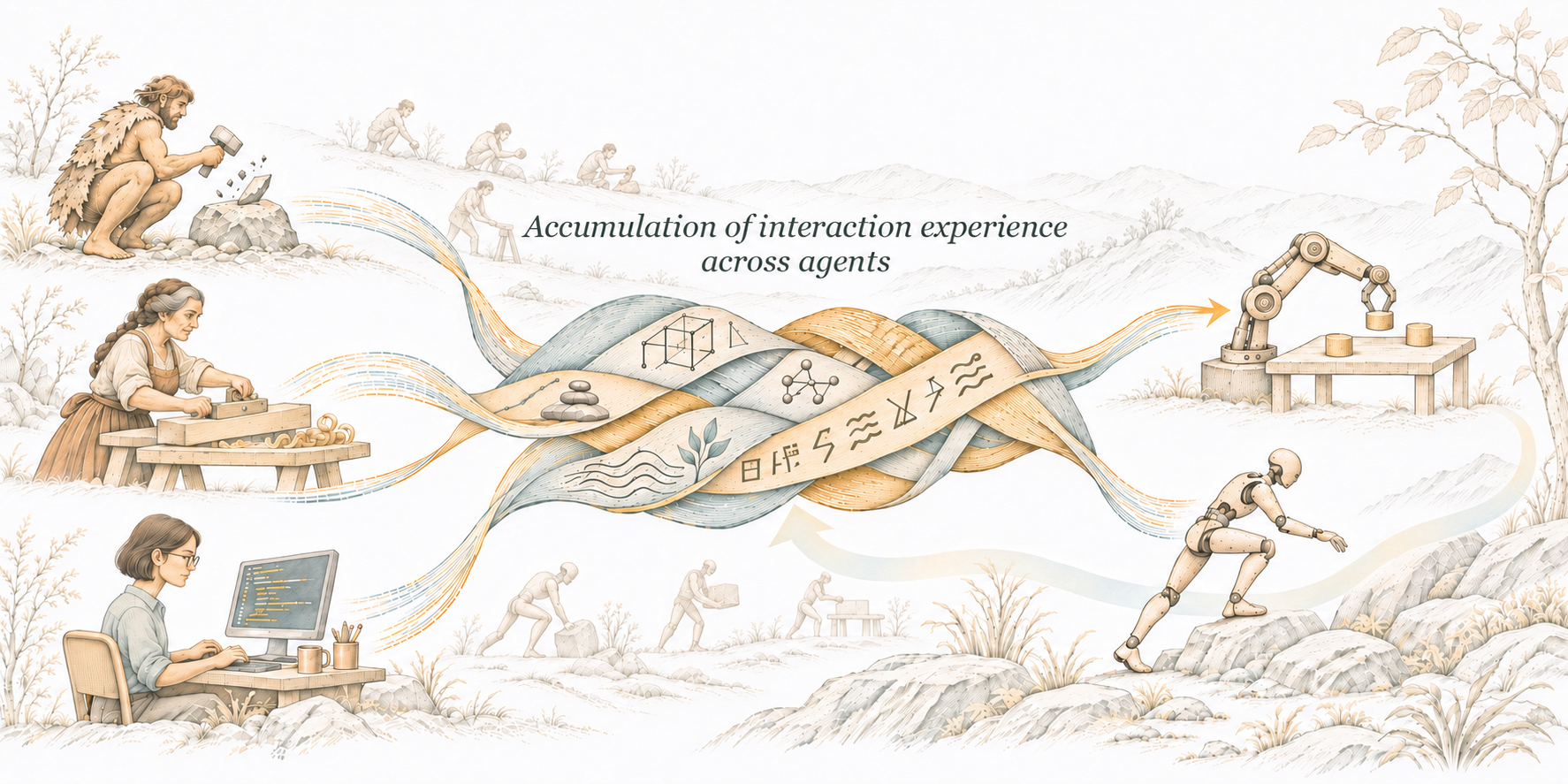
Every interaction has a cost in time and energy, so the experience any individual agent can acquire firsthand is limited in both quantity and diversity. If individuals could learn only from their own experience, each would have to repeat explorations others had already completed. Accumulation and reuse across individuals are therefore particularly important for developing sufficient generality within a limited interaction budget [3]. In this sense, there are at least two important ways in which such accumulation occurs:
Evolution passes on traits that helped previous generations adapt, so each new generation starts with abilities and learning biases shaped by the past [4].
Culture allows individuals to pass on acquired knowledge and skills through demonstration, language, writing, and other means, enabling others to build on what has already been learned [5].
Seen this way, biological intelligence builds on the accumulated effects of countless individuals’ interactions with their environments, passed down through evolution. Humans developed language and writing, and eventually the internet, allowing knowledge and experience to be shared and accumulated on an ever larger scale [6].
So, are language models the only path to embodied intelligence?
Language may not be a necessary computational form for embodied intelligence, but it allows agents to draw on far more than they could ever experience firsthand. In this sense, language pretraining may not be merely an engineering choice.
As substantial resources continue to flow into this route, it is likely to be the first to succeed, narrowing the space and time available to explore alternatives. Ultimately, even if language models are not the only path in theory, they may become an unavoidable choice in practice.
Building on the foundation of intelligence acquired through language pretraining, I still believe that online, embodied interaction with the environment—whether in simulated sandboxes or the real world—is needed to achieve truly general-purpose embodied intelligence. In this process, the cost of interacting with the physical world limits the efficiency of individual agents’ experience acquisition. This makes the accumulation of intelligence across agents especially important.
Along this path, more and more questions arise:
How can language models incorporate tactile and force sensing, and generate continuous actions? How can decision-making by foundation models be coupled with high-frequency, low-level control?
Can we extract the capabilities that language models bring to embodied AI, such as spatial perception and decision-making, into smaller models that retain as much generality as possible while reducing the cost of interaction?
How can we measure the gains in an embodied agent’s capabilities from interaction? How do the contributions of its own interactions compare with those of knowledge and skills accumulated across agents? What must an agent learn through direct interaction, and what can it acquire from other agents?
How will embodied agents accumulate and share what they learn through interaction—through human language and culture, an AI-native language, or some form of evolution?
Could robots discover knowledge and skills unknown to humans through embodied interaction, and in turn expand our understanding of the physical world? In the digital world, AI has already made discoveries that humans can build on [7]. Could robots do the same through interaction with the physical world, expanding what we understand and can do? Human knowledge is a starting point, but need not be the limit of what robots can discover.
Language models can already represent feelings and emotions symbolically through language. If embodied agents can ground these representations in their own bodily experiences, how should we respond to the potential ethical implications?
General-purpose embodied intelligence may (soon) become a reality. I see answering these questions as a challenge, an opportunity, and a responsibility for our generation of researchers.

Postscript: This past weekend, I had the pleasure of joining three days of discussions at Mini3DV, amid the autumn colors, lakeside scenery, and pagoda reflections of Yanqi Lake in Beijing. One of the most intensely discussed topics was the relationship between large language models and the development of embodied intelligence, including the debate between learning intelligence natively through embodied interaction and inheriting capabilities from pretrained language models. This short essay brings together my thoughts, inspired by conversations with many colleagues to whom I am grateful. Views are my own.
References
- OpenAI. (2026). GPT-6 Astra: A new generation of intelligence. ↩
- Zhu, W. (2026). GPT-6 Astra: 3D, Embodied AI, and Beyond. ↩
- Cook, J., Lu, C., Hughes, E., Leibo, J. Z., & Foerster, J. (2024). Artificial Generational Intelligence: Cultural Accumulation in Reinforcement Learning. Advances in Neural Information Processing Systems, 37. ↩
- Zador, A. M. (2019). A critique of pure learning and what artificial neural networks can learn from animal brains. Nature Communications, 10, 3770. ↩
- Boyd, R., Richerson, P. J., & Henrich, J. (2011). The cultural niche: Why social learning is essential for human adaptation. PNAS, 108 (Supplement 2), 10918–10925. ↩
- Tomasello, M. (1999). The Cultural Origins of Human Cognition. Harvard University Press. ↩
- Novikov, A., et al. (2025). AlphaEvolve: A coding agent for scientific and algorithmic discovery. Google DeepMind technical report, arXiv:2506.13131. ↩